Walk into any accountant’s office in Lahore, Karachi, or Islamabad and ask what software they use. You will get a different answer almost every time. QuickBooks in one office. PACT in another. A custom-built system in a third. And increasingly in 2026 — Odoo.
Pakistan’s accounting software landscape is genuinely fragmented. Unlike some markets where one or two platforms dominate completely, Pakistani businesses use a wide variety of tools — each with its own loyal user base, its own strengths, and its own significant limitations in the context of Pakistan’s evolving tax compliance requirements.
This guide does not just list software options. It tells you what Pakistani businesses are actually using, why they chose it, and — most importantly — whether those choices still make sense in 2026 when FBR’s digital invoicing mandate has changed the compliance landscape permanently.
Want to find out which accounting software is right for your business? Get a free consultation from MantechIT →
The Pakistani Accounting Software Landscape in 2026
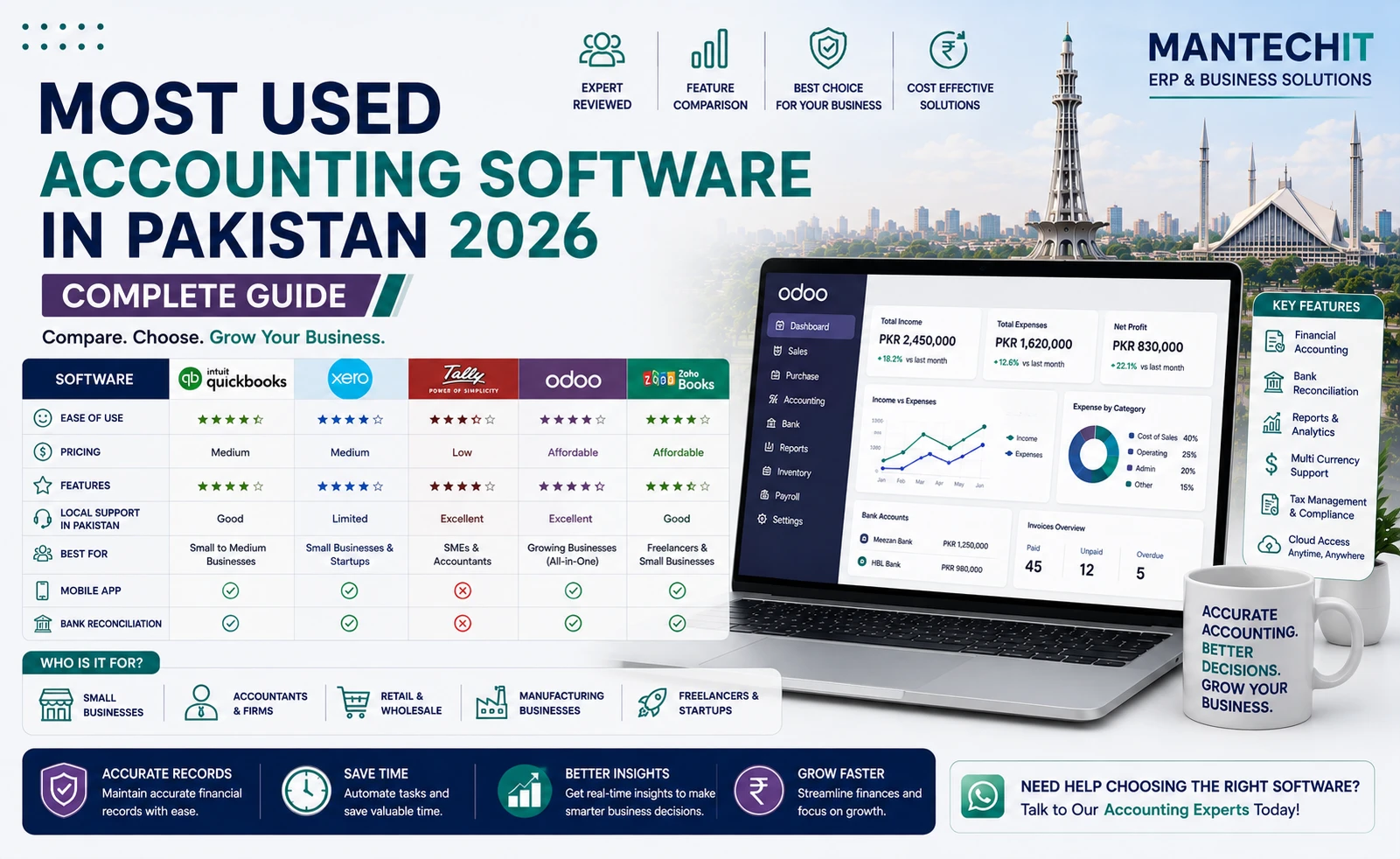
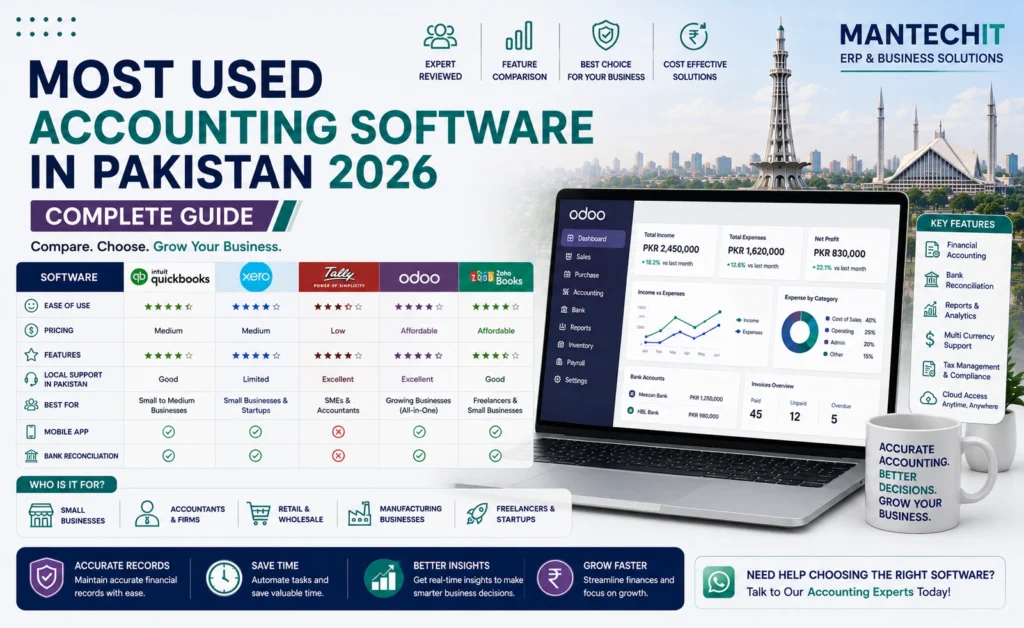
Before diving into individual products, here is the honest picture of what Pakistani businesses use:
| Software | Market Segment | Estimated Users | FBR IRIS Ready |
|---|---|---|---|
| QuickBooks (Desktop) | SMEs, trading companies | Very high | ❌ Not native |
| PACT | Small businesses, shops | High | ⚠️ Partial |
| Odoo | Growing fast — SMEs to large | Rapidly growing | ✅ Yes |
| Tally ERP | Some mid-size businesses | Moderate | ❌ Not for Pakistan |
| Custom systems | Large enterprises, specific industries | Moderate | ⚠️ Varies |
| Xero | Freelancers, overseas-facing | Low | ❌ No |
| SAP Business One | Large enterprises | Low | ⚠️ Custom |
| Wave / Zoho | Freelancers, startups | Low | ❌ No |
The most striking trend in 2026 is the shift away from standalone accounting tools toward integrated ERP systems — driven primarily by FBR’s mandatory e-invoicing requirements. Businesses that used to manage with QuickBooks or PACT are discovering that these tools cannot handle real-time IRIS transmission, and they are migrating.
Most Used Accounting Software in Pakistan — Detailed Review
1. QuickBooks — Pakistan’s Most Familiar Accounting Software
Why it became popular: QuickBooks entered Pakistan’s market through local resellers and became deeply embedded in the accounting profession. Most Pakistani accounting graduates learned QuickBooks in college. Most accounting job postings listed “QuickBooks proficiency” as a requirement for years. It became the default — not necessarily because it was the best, but because it was what everyone knew.
Which version do Pakistani businesses use? Primarily QuickBooks Desktop (Pro, Premier, and Enterprise) rather than QuickBooks Online. This is because the desktop version is available through local resellers at a one-time cost, while the online version requires a recurring USD subscription that has become expensive at current exchange rates.
What QuickBooks does well for Pakistan:
- Clean, intuitive accounting interface familiar to most Pakistani accountants
- Good double-entry bookkeeping and financial statement generation
- Reasonable invoicing and expense tracking
- Job costing features in Premier and Enterprise editions
- Large local user base — easy to find staff who know it
Where QuickBooks falls short in 2026:
- No FBR IRIS integration — every invoice must be manually uploaded to FBR’s portal separately
- No proper inventory management for distributors and manufacturers
- No manufacturing module — production order management simply does not exist
- No Pakistani payroll — EOBI, PESSI, and income tax must be managed separately
- QuickBooks Desktop is being discontinued globally — Intuit is pushing users to the online version, creating uncertainty for desktop users
- USD pricing for QuickBooks Online — expensive at current PKR/USD rates
Who still uses QuickBooks in Pakistan: Small trading companies, service businesses, and freelancers where basic accounting is sufficient and FBR e-invoicing pressure is minimal. Many businesses continue using it despite its limitations — simply because their accountant knows it and switching seems daunting.
The honest verdict: QuickBooks was the right tool for 2015 Pakistan. In 2026, with FBR’s real-time e-invoicing mandate, it is becoming a liability. Businesses using QuickBooks are either paying extra staff to manually upload to IRIS — or they are non-compliant.
2. PACT — Pakistan’s Home-Grown Accounting Solution
Why it became popular: PACT (Pakistan Accounting and Costing Technology) is one of Pakistan’s longest-established locally-developed accounting packages. It was built specifically for Pakistani businesses — with Pakistani tax requirements, Pakistani chart of accounts structures, and Urdu-language support. For businesses that found international software either too expensive or too generic, PACT was the local solution.
What PACT does well for Pakistan:
- Built specifically for Pakistani tax law — WHT, sales tax, advance tax configured locally
- Urdu language support for businesses that prefer it
- One-time local purchase — no USD subscription
- Local vendor — local support
- Familiar to many Pakistani bookkeepers and accountants
- Reasonable pricing for small businesses
Where PACT falls short in 2026:
- FBR IRIS integration is inconsistent across versions — some have partial integration, few have live API
- Limited scalability — most PACT versions struggle beyond 10–15 concurrent users
- Weak inventory management — adequate for simple trading but insufficient for distributors
- No manufacturing module
- Uncertain upgrade path — as FBR requirements evolve, local software houses vary in their ability to keep up
- Limited mobile and remote access
Who uses PACT in Pakistan: Small retail shops, local trading companies, small service businesses, and businesses in smaller cities where international software support is limited.
The honest verdict: PACT serves a specific segment well — small Pakistani businesses that need basic accounting with Pakistani tax awareness. As FBR’s requirements grow more sophisticated, PACT’s limitations become more apparent. It remains a reasonable starting point but is not a long-term solution for growing businesses.
3. Odoo — Pakistan’s Fastest-Growing Accounting & ERP Platform
Why it is growing rapidly: Odoo’s growth in Pakistan is being driven by two forces: FBR’s e-invoicing mandate (which basic accounting software cannot handle) and Pakistan’s expanding manufacturing and distribution sectors (which need more than accounting). Odoo is the only platform that covers accounting, inventory, manufacturing, HR, and FBR compliance in one integrated system — at a price accessible to Pakistani SMEs.
What Odoo does for accounting in Pakistan:
The basics — done better:
- Full double-entry accounting with complete audit trail
- Multi-currency with PKR as base
- Automated bank reconciliation with smart matching
- Detailed financial statements — P&L, balance sheet, cash flow
- Budget management with variance analysis
- Aged receivables and payables
- Consolidated financials for multi-entity businesses
The Pakistan-specific features that matter most:
- Live FBR IRIS API integration — every invoice auto-transmitted in real time
- PRA/SRB service tax — configured for Punjab and Sindh service businesses
- Section 153/154/155 WHT automation — deducted and reported automatically
- EOBI and PESSI payroll — compliant with Pakistani labour law
- Export zero-rating — fiscal position for export customers
- Federal Excise Duty — tax component for applicable products
- Monthly sales tax return — auto-compiled from IRIS data
The integration that changes everything: Because Odoo accounting is not standalone — every inventory movement, every purchase, every production order, every payroll run flows directly to accounting. No manual journals. No reconciliation between systems. No month-end panic.
Pricing:
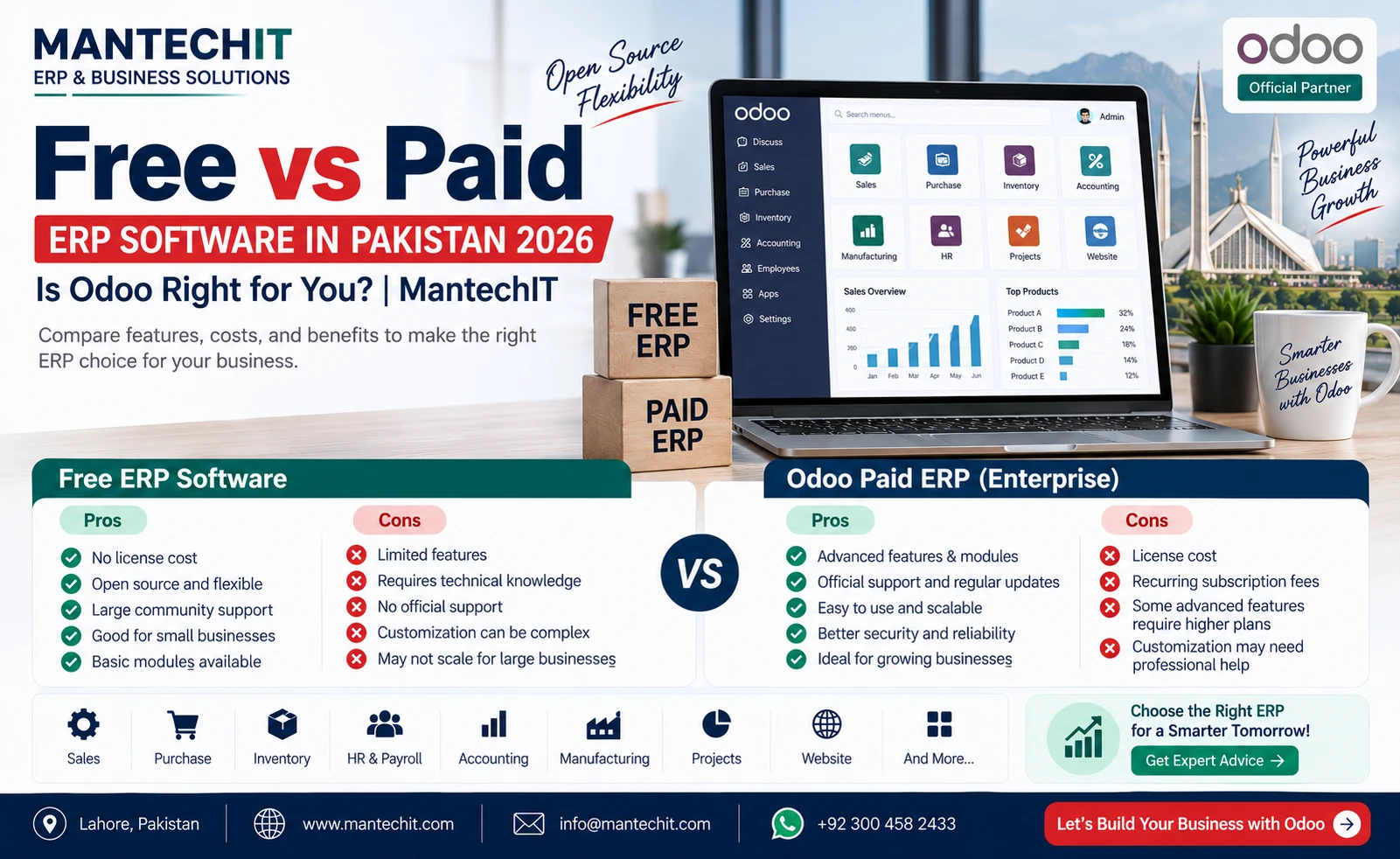
- Community Edition: PKR 0 licensing + implementation
- Enterprise Edition: ~PKR 7,000/user/month
Who is moving to Odoo in Pakistan: Businesses that have outgrown QuickBooks or PACT. Manufacturers who need production management alongside accounting. Distributors who need multi-warehouse inventory connected to accounts. Retailers who need FBR Tier-1 POS. Pharmaceutical companies who need DRAP batch tracking alongside FBR compliance.
The honest verdict: Odoo is the most complete accounting and business management solution available for Pakistani businesses in 2026. The upfront implementation cost is higher than QuickBooks or PACT — but the total value delivered is incomparably greater.
4. Tally ERP — Popular in India, Limited in Pakistan
Why some Pakistani businesses use it: Tally is the dominant accounting software in India — and some Pakistani businesses, particularly those with cross-border trade relationships or Indian-trained accountants, have adopted it.
Pakistan-specific limitations:
- Built for Indian tax law (GST India, TDS India) — Pakistani tax rules require heavy customization
- No FBR IRIS integration
- No Pakistani payroll compliance (EOBI, PESSI)
- Limited local support in Pakistan
- Not designed for export zero-rating under Pakistan’s regime
The honest verdict: Tally works well in India. In Pakistan, it requires significant customization to function compliantly and even then lacks FBR integration. Not recommended for businesses operating within Pakistan’s tax system.
5. Xero — Modern Cloud Accounting, Wrong Market for Pakistan
Why some Pakistani freelancers use it: Xero is popular among Pakistani freelancers and remote workers serving international clients — particularly those working with Australian, UK, or New Zealand companies that use Xero. For matching a client’s accounting system, it makes sense.
Pakistan-specific limitations:
- No FBR IRIS integration whatsoever
- No Pakistani tax configuration
- No Pakistani payroll module
- Priced in USD — expensive at current exchange rates
- No meaningful local implementation support
The honest verdict: Useful only for Pakistani freelancers matching international clients’ systems. Entirely unsuitable for businesses operating within Pakistan’s domestic tax environment.
6. SAP Business One — Enterprise Option, Rare in Pakistan
Why large Pakistani enterprises use it: SAP Business One is the world’s most widely deployed mid-market ERP. Some large Pakistani manufacturing groups, subsidiaries of multinationals, and companies with complex multi-entity structures use it.
Pakistan-specific reality:
- FBR IRIS integration requires expensive custom development
- Implementation costs PKR 8M–15M+
- Very limited certified SAP partners in Pakistan
- Annual maintenance fees are substantial
- Overkill for businesses under PKR 500M annual turnover
The honest verdict: Appropriate for Pakistan’s largest enterprises. Completely impractical for SMEs and mid-size businesses.
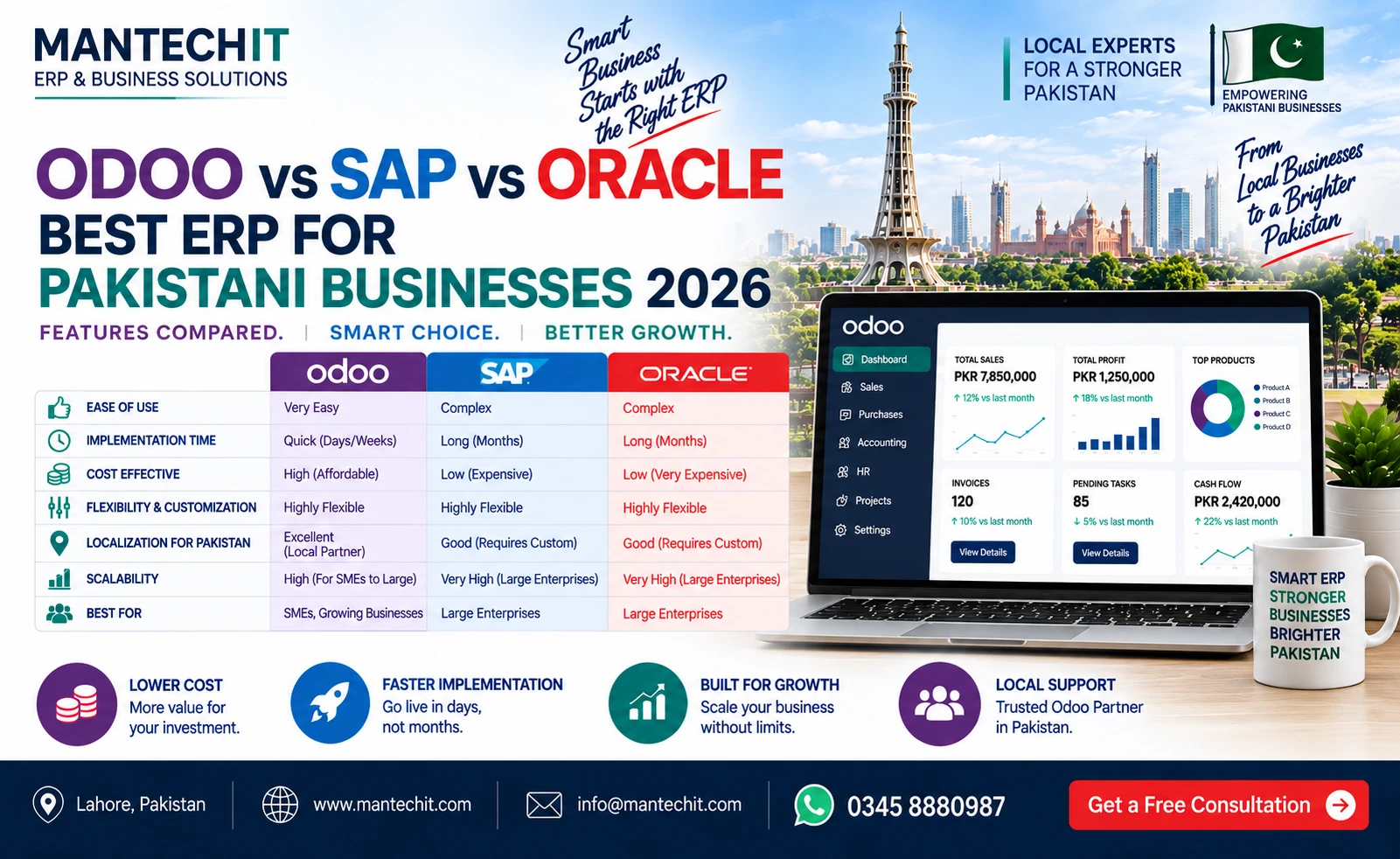
Related: Odoo vs SAP vs Oracle — Best ERP for Pakistani Businesses 2026 →
7. Custom-Built Accounting Systems
Who uses them: Large Pakistani businesses with very specific operational requirements — certain banks, large retailers, government-linked enterprises — sometimes use custom-built accounting systems developed specifically for their workflows.
Risks:
- Dependent on the original developer for maintenance
- FBR API updates require custom development each time
- No upgrade path when requirements change dramatically
- Often expensive to maintain and modify
The honest verdict: Justified only for businesses with genuinely unique requirements that no existing software can serve. For most Pakistani businesses, this is the most expensive and highest-risk option.
The FBR Factor — Why 2026 Is a Turning Point
Here is why the most-used accounting software in Pakistan is changing rapidly:
FBR’s mandatory real-time e-invoicing has created a hard dividing line. Software that does not connect to IRIS via API is no longer adequate for registered Pakistani businesses. This means:
QuickBooks — requires manual IRIS uploads. For a business issuing 50+ invoices daily, this is unsustainable.
PACT — partial integration in some versions. Reliability varies. Not a long-term compliance solution.
Tally, Xero, Wave — no Pakistan FBR integration at all.
Odoo — live API integration, tested and working in production across Pakistan.
This single factor is driving a significant shift in Pakistan’s accounting software market. Businesses that previously had no reason to change are now being pushed to migrate by FBR compliance requirements.
What Pakistani Accountants Actually Prefer
Talking to Pakistani chartered accountants, CFOs, and finance managers reveals some consistent preferences:
What they value most:
- FBR compliance capability — increasingly the #1 requirement
- Ease of use for their team
- Quality of reporting — P&L, balance sheet, receivables aging
- Integration with inventory and operations
- Local support availability
What they find most frustrating with current tools:
- Manual FBR uploads eating staff time
- Disconnected systems — accounting in one tool, inventory in another
- WHT calculations done manually in Excel
- Monthly return preparation taking a full week
- Inability to get real-time profitability data
The shift in thinking: Five years ago, most Pakistani CFOs thought of accounting software as a standalone tool. Today, the best Pakistani finance teams are pushing for integrated ERP — because they have seen the efficiency difference. The question has shifted from “which accounting software?” to “which ERP covers our accounting properly?”
City-by-City: Most Popular Accounting Software in Pakistan
Lahore
QuickBooks still has a large user base — particularly among older businesses with established accounting teams trained on it. But Odoo adoption is growing fastest here — driven by Lahore’s large manufacturing and distribution sector that needs more than basic accounting. MantechIT serves Lahore businesses from its Johar Town office.
Karachi
Pakistan’s commercial capital has the most diverse software landscape. Large trading companies often use QuickBooks or SAP. Manufacturing and pharmaceutical companies are increasingly moving to Odoo. SRB service tax requirements make proper tax configuration critical.
Faisalabad
Textile and manufacturing dominance means accounting needs extend far beyond basic bookkeeping — production costs, raw material inventory, export documentation. Odoo adoption is growing rapidly among Faisalabad’s manufacturing sector.
Islamabad / Rawalpindi
Government contractors, IT companies, and consultancies dominate. QuickBooks is common. PRA service tax compliance is a key requirement. Growing interest in Odoo among IT and services companies.
Sialkot
Export-oriented sporting goods and surgical instrument manufacturers need accounting tied to export documentation, zero-rating, and international buyer compliance. Odoo is increasingly the choice for serious exporters.
Making the Switch — When to Move From Your Current Software
Move from QuickBooks to Odoo when:
- You are issuing 20+ invoices daily and manually uploading to IRIS
- You need proper inventory management alongside accounting
- Your business has grown beyond 10–15 users
- You need manufacturing or production cost tracking
- FBR compliance is consuming too much of your team’s time
Move from PACT to Odoo when:
- Your business has grown beyond 10 users
- FBR IRIS integration is unreliable or unavailable in your PACT version
- You need multi-warehouse inventory management
- You need HR and payroll integrated with accounting
- You want mobile and remote access for management
Stay with your current software when:
- You are a freelancer with simple income/expense tracking needs
- Your business has fewer than 5 staff and minimal FBR obligations
- You are genuinely satisfied with current FBR compliance capability
- You plan to migrate to proper ERP within 12 months anyway
Conclusion: The Most Used Is Not Always the Most Suitable
QuickBooks is the most familiar accounting software in Pakistan. PACT is the most locally-adapted standalone option. But in 2026, with FBR’s real-time e-invoicing mandate reshaping compliance requirements — the most-used is rapidly becoming the most-limiting.
The Pakistani businesses that are getting ahead in 2026 are those that have recognised the shift: accounting software is no longer adequate on its own. The competitive advantage goes to businesses running integrated ERP — where accounting, inventory, production, HR, and FBR compliance work together in one system.
Odoo, implemented by MantechIT, delivers this integration at a cost accessible to Pakistani SMEs — starting from PKR 300,000 for a complete, FBR-compliant implementation.
Find Out What’s Right for Your Business — Free Consultation
MantechIT will assess your current accounting software, identify the compliance gaps, and show you exactly how Odoo covers everything your business needs.
📞 Call: +92 (345) 888-0987 📍 Visit: Office 8, 1st Floor, Block E, Johar Town, Lahore 🌐 Book Free Consultation → 🗺️ Serving: Lahore · Karachi · Islamabad · Faisalabad · Sialkot · Gujranwala · Rawalpindi · Multan · All of Pakistan