MantechIT implements Odoo Food & Beverage ERP for Pakistani manufacturers — recipe management, batch expiry tracking, PSQCA and HACCP documentation, FBR Federal Excise Duty invoicing and actual production cost per batch running in one connected system.
A contaminated batch reaching the market. An expired ingredient used in production because nobody checked. A PSQCA inspector arriving at the factory with no notice. These are not theoretical risks for food and beverage manufacturers in Pakistan — they are operational realities that disconnect ERP systems cannot prevent.
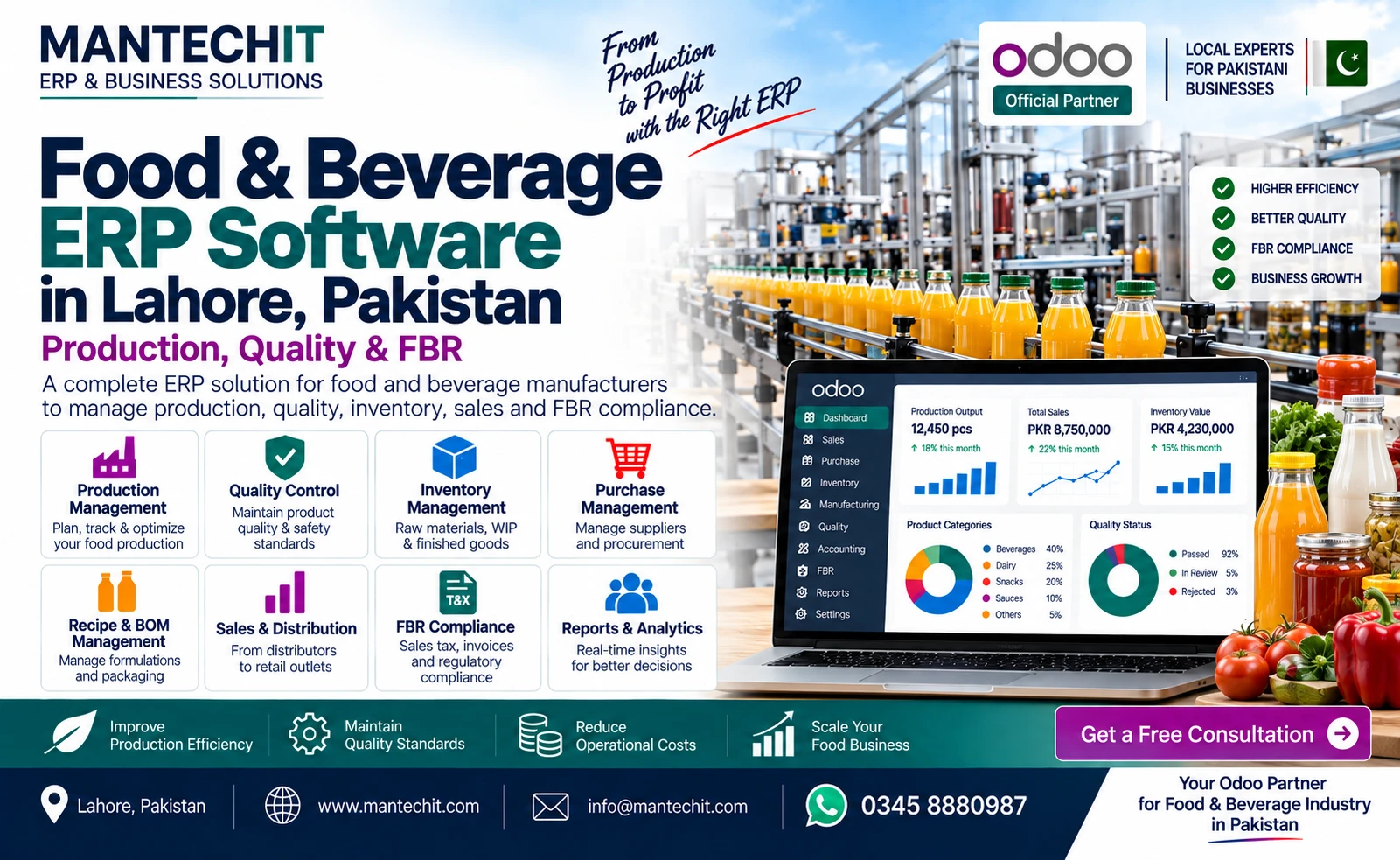
Every module configured around Pakistan’s food safety regulatory requirements and your specific production model — then supported by MantechIT’s local team in Johar Town.
Every product formulation defined in Odoo as a Bill of Materials — raw ingredient quantities per batch size, packaging materials per SKU, and processing parameters as production instructions. Recipe library maintains every approved formulation with version history — when a recipe is updated, the previous version is retained for batch traceability purposes. Multi-level BOM handles semi-finished intermediates — a juice concentrate BOM feeds into the finished juice product BOM, with costing calculated through both levels automatically.
Every production batch assigned a unique batch number in Odoo — linked to the raw material lots used, the production date, the best-before date and the production operator. Finished goods inventory tracked at batch level — not just product level. FEFO (First Expiry First Out) picking enforced at dispatch — oldest batch always leaves the warehouse first without relying on warehouse staff to remember which pallet arrived when. Batch recall readiness built into every stock movement — find every customer who received a specific production batch in under ten minutes if a quality issue is discovered in the market.
Critical control points defined in Odoo's quality module — pasteurisation temperature and hold time for dairy, Brix reading at filling for juice, pH measurement for fermented products, metal detection pass or fail for packaged foods. QC results recorded against each production batch at each CCP automatically — creating a complete HACCP record without any separate documentation system. Incoming raw material quality checks recorded before ingredients are accepted into the production store — supplier CoA attached to each incoming lot. Retention samples logged per batch with location and review date. PSQCA audit documentation generated from Odoo records in hours rather than weeks.
Actual raw material consumption recorded per production batch against the BOM standard — variance between recipe quantity and actual quantity flagged immediately. Labour cost allocated per shift per production line from confirmed attendance records. Energy and overhead costs allocated per batch by configured method. True cost per unit of finished goods calculated automatically from actual inputs — not estimated from standard costs that drift from reality. Underperforming batches identified by actual yield versus theoretical yield without waiting for month-end accounts.
Historical sales data by product by period analysed in Odoo to generate forward demand forecasts. Ramadan production calendar planned from the forecast — raw material purchasing scheduled to ensure stock is in place before the demand surge, not during it. Summer and winter demand patterns for beverages and dairy products reflected in production schedules. Procurement lead times built into the forecast model — purchase orders triggered at the right time for the right quantity based on actual demand patterns rather than the production manager's experience.
Federal Excise Duty applied automatically on carbonated beverages and other FED-applicable product categories at the correct rate — without the accounts team selecting FED manually on each invoice line. Standard GST applied on processed food products per category. Exempt status applied on basic food staples where applicable under current SRO notifications. Mixed invoices — a single delivery to a distributor containing FED beverages, GST-applicable packaged foods and exempt items — transmitted to FBR IRIS with the correct tax category for each line automatically. Monthly sales tax and FED return compiled from IRIS data in under three hours.
Separate inventory locations in Odoo for ambient, chilled and frozen storage — stock cannot be transferred between temperature zones without a formal transfer record. Temperature-sensitive products — dairy, certain beverages, chilled ready meals — flagged with storage condition requirements at product level. Cold chain documentation attached to outgoing shipments — delivery temperature records for distribution vehicles carrying chilled or frozen products. Supplier cold chain compliance documented at goods receipt for raw materials requiring temperature-controlled delivery.
Finished goods distribution to FMCG distributors, modern trade accounts and institutional buyers managed through Odoo's sales and delivery modules. Route-to-market pricing configured per customer segment — distributor price, modern trade price, institutional price applied automatically per customer without manual selection. Van sales for secondary distribution tracked through mobile app — daily loading confirmed before departure, deliveries recorded in real time, returns captured and credited on the same device. Expiry date visible on every picking document — delivery teams can see product best-before date before loading.
The core capability set built into every F&B rollout — configured for PSQCA compliance, FED invoicing and batch-level production control from day one.
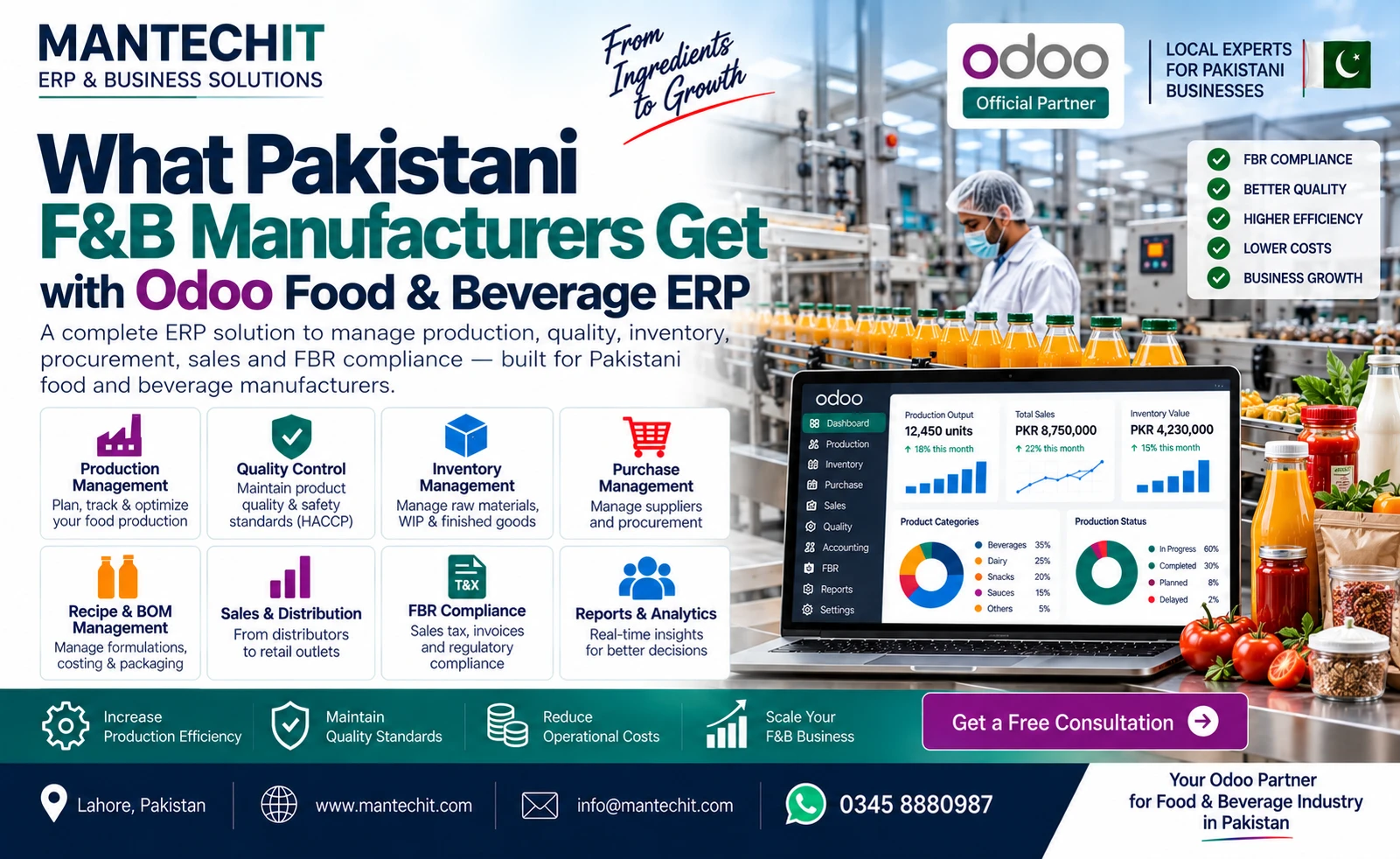
Lahore’s food and beverage manufacturing sector is one of the most diverse in Pakistan. Juice and beverage plants in Sundar Industrial Estate. Dairy processing units on Raiwind Road. Confectionery and biscuit manufacturers in Kot Lakhpat. Spice processors and condiment producers in Quaid-e-Azam Industrial Estate. Packaged snack manufacturers supplying national retail chains. And a growing ready meals and catering manufacturing segment serving Lahore’s expanding food service market.
What these businesses share — regardless of product category — is the same operational challenge. Production runs continuously. Raw material quality varies between supplier lots. Regulatory requirements from PSQCA, DRAP for functional foods, and FBR for tax compliance demand documentation that paper systems cannot reliably maintain. And the margin between a profitable production run and a loss-making one often comes down to two or three percent of raw material yield — which is only visible if actual consumption is measured against recipe standards in real time.
MantechIT’s Food & Beverage ERP gives Lahore manufacturers the batch-level production visibility, regulatory documentation infrastructure and financial accuracy that disconnected systems cannot provide.
Juice and beverage manufacturers in Lahore — producing fruit juices, flavoured drinks, bottled water, energy drinks and carbonated beverages — deal with some of the most demanding quality and tax compliance requirements of any food category. Brix levels at filling must hit specification for product consistency. Pasteurisation temperature and hold time must be documented for each batch. Carbonated beverages attract Federal Excise Duty that must be correctly applied alongside standard GST on the same customer invoice. And batch traceability from the fruit concentrate lot to the finished bottle must be maintained for both PSQCA compliance and market recall readiness.
MantechIT’s beverage manufacturing configuration records Brix reading, pH and pasteurisation temperature as in-process quality checkpoints in Odoo — linked to the specific production batch. FED is applied automatically on carbonated beverage lines while standard GST is applied on non-carbonated lines on the same invoice — no manual tax selection, no risk of incorrect FED application on an exempt product or vice versa. Batch traceability links every finished goods lot to the concentrate lot, processing date and filling line — a recall trace completed in minutes rather than days.
Dairy processors on Raiwind Road and in Lahore’s peri-urban processing areas — producing pasteurised milk, yoghurt, butter, cheese and dairy-based drinks — manage one of the most perishable raw material supply chains in food manufacturing. Incoming milk quality — fat percentage, SNF content, total bacterial count — varies between suppliers and between collection rounds. Pasteurisation records must document temperature and hold time for every batch. Finished products have shelf lives measured in days for fresh dairy and weeks for processed formats — requiring FEFO distribution discipline that manual systems cannot reliably enforce.
Odoo’s dairy configuration records incoming milk quality parameters at goods receipt — fat, SNF and bacterial count entered per collection lot. Pasteurisation temperature and hold time recorded as mandatory QC fields on every production batch — the batch cannot be released to finished goods storage until these parameters are confirmed within specification. Shelf life calculated automatically from production date per the configured shelf life for each product format. FEFO enforced at every dispatch — the batch closest to its best-before date always dispatched first. Near-expiry alerts generated before product reac
Confectionery, biscuit and packaged snack manufacturers in Lahore — supplying national retail chains, modern trade accounts and international export markets — face a production environment where recipe consistency is the foundation of brand reputation. A biscuit that tastes different from one production run to the next, or a snack with variable texture because oil absorption was not measured against specification, generates consumer complaints and retailer returns that damage brand equity and margin simultaneously.
MantechIT’s confectionery and snacks configuration enforces recipe discipline through Odoo’s BOM and production order system. Raw material issuance to production is measured against the recipe quantity — overages and shortages flagged before they become a batch quality problem. Critical process parameters — dough temperature, baking time and temperature, nitrogen flushing pressure for shelf-life protection — recorded as in-process QC checkpoints per batch. Finished goods release held until QC sign-off confirms the batch meets the approved specification for moisture, weight per piece and sensory evaluation. Packaging material consumption tracked against BOM standards — film waste identified per production run.
Spice processors and condiment manufacturers in Lahore’s industrial zones — supplying both retail consumer packs and bulk institutional buyers — deal with a raw material supply that is heavily dependent on seasonal agricultural cycles, creating procurement timing challenges that most ERP systems handle poorly. Chilli prices spike after a poor crop. Cumin availability varies between harvest seasons. Turmeric quality differs between origins. And the processing business that buys at the wrong time or the wrong quality pays the penalty in finished product cost and consistency for the following six to twelve months.
Odoo’s procurement planning module gives Lahore spice processors forward visibility of raw material requirements from the demand forecast — showing how many tonnes of each spice the production schedule requires over the next three to six months. This demand signal drives purchasing decisions made months ahead of requirement rather than weeks — giving the procurement team time to source at the right quality and the right price rather than accepting whatever is available when the production line stops.
Batch traceability links every finished goods lot to the raw spice lots used — including the origin, crop year and supplier. When a product quality complaint is received in the market, the specific raw material lot is identified immediately and its disposition across all production batches is traced in Odoo without manual record searching.
Pakistan’s food and beverage manufacturers face one of the most complex tax compliance environments of any manufacturing sector. Basic unprocessed food is exempt from GST. Most packaged and processed food products carry standard 17% GST. Carbonated beverages attract Federal Excise Duty at a specific rate in addition to or in lieu of GST depending on the product category. And zero-rating applies on food exports.
Most Lahore F&B manufacturers are managing this complexity manually — selecting tax rates line by line on customer invoices and periodically discovering that FED has been applied to a non-carbonated product or that GST has been applied to an exempt food item. Each error is both a compliance risk with FBR and a financial error on the customer’s invoice.
MantechIT configures Odoo’s tax engine with Pakistan’s food and beverage tax structure applied per product category — so the correct tax treatment is applied automatically on every invoice line without manual selection. FED on carbonated beverages, standard GST on packaged foods, exempt status on basic staples and zero-rating on export invoices all determined by product configuration rather than accounts team decision on each individual invoice. Monthly FED and GST return compiled from IRIS-transmitted invoice data automatically — separated by tax type and reconciled against input tax on purchases.
MantechIT is an Official Odoo Partner headquartered in Johar Town, Lahore — with food and beverage ERP implementations across juice manufacturers, dairy processors, confectionery producers, spice processors and packaged food manufacturers in Lahore, Karachi and Faisalabad.
Our F&B ERP template is built specifically around Pakistan’s food manufacturing regulatory environment — PSQCA critical control point configuration, batch manufacturing records with mandatory QC fields, FEFO inventory enforcement, FED and mixed food tax configuration, cold chain storage location management, and demand forecasting for seasonal production planning. These are tested configurations from live F&B implementations — not theoretical capabilities built from scratch on your project timeline.
Factory visits to your Sundar Industrial Estate, Raiwind Road or Quaid-e-Azam Industrial Estate facility are a standard part of our implementation. We walk your production floor, map your actual CCP workflow, configure Odoo’s quality module to match your specific product categories, and train your production supervisors, QC team and accounts staff in person. PSQCA and HACCP documentation setup is done with your QA manager present — so the records Odoo generates are in the format your regulatory team actually needs for audit.
Serving food and beverage businesses across: Sundar Industrial Estate · Raiwind Road · Kot Lakhpat · Quaid-e-Azam Industrial Estate · Sheikhupura Road · All of Lahore · Karachi · Faisalabad · Multan
Odoo ERP implementation, customization, business automation and FBR digital invoicing integration for businesses in Lahore and across Pakistan.
Quick Links
ERP Solutions
© 2026 Mantechit.com All Rights Reserved.