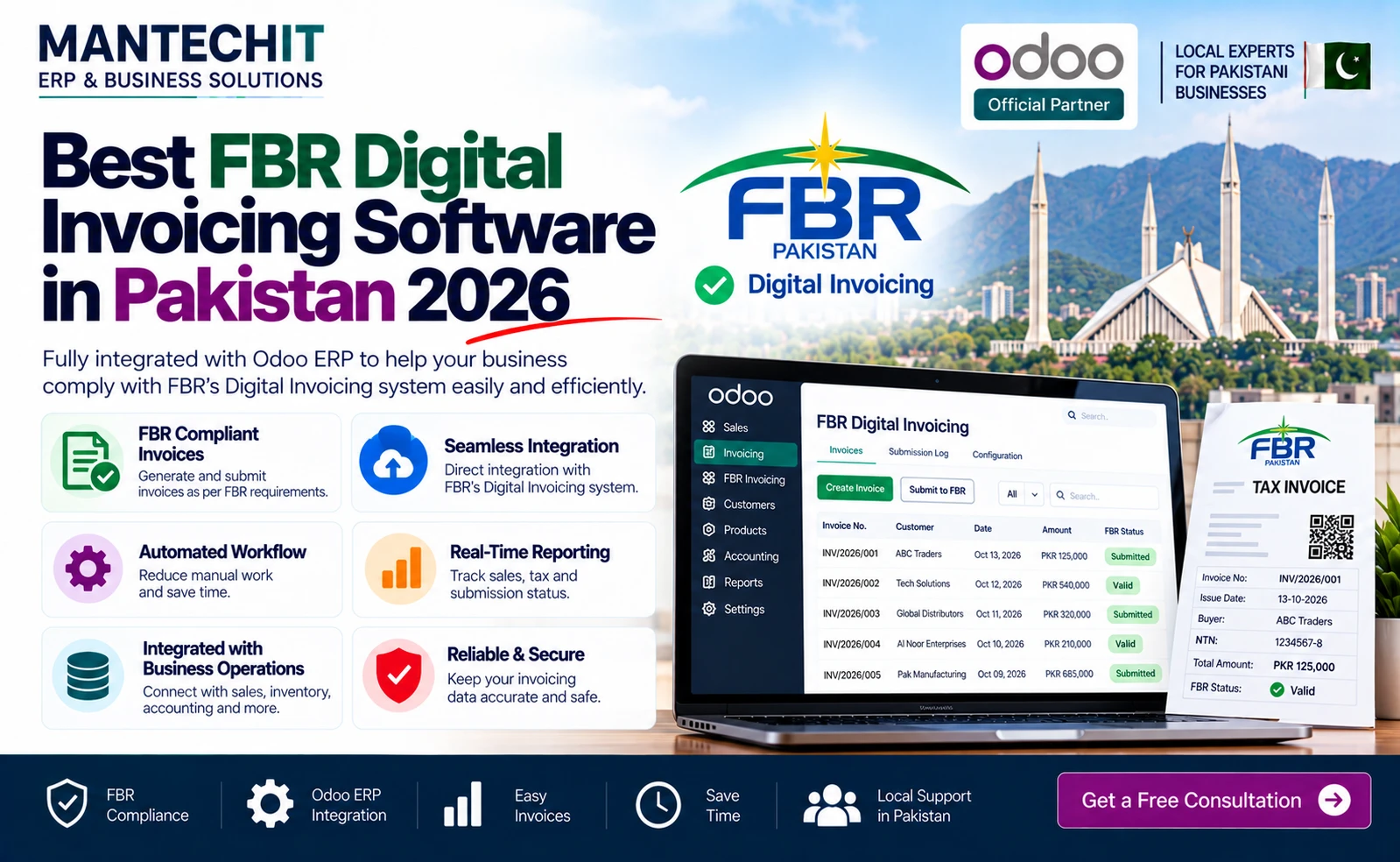
The Federal Board of Revenue (FBR) has fundamentally changed how Pakistani businesses must manage their invoicing. Gone are the days when a handwritten receipt or a basic computer-printed invoice was sufficient for tax compliance. In 2026, FBR requires businesses across Pakistan — retailers, manufacturers, distributors, service providers, and exporters — to issue digitally verified invoices transmitted in real time to FBR’s IRIS portal.
The penalties for non-compliance are not theoretical. FBR has been actively enforcing digital invoicing requirements — sealing non-compliant businesses, imposing fines, and conducting surprise audits that have caught hundreds of businesses across Lahore, Karachi, Faisalabad, and other major cities off-guard.
Yet despite this enforcement reality, thousands of Pakistani businesses are still managing their invoicing through disconnected systems — typing invoices in Word, generating bills in QuickBooks without any FBR integration, or using standalone POS machines that transmit nothing to IRIS.
The solution is FBR-integrated digital invoicing software — and in this guide, we explain exactly what FBR requires, which software options are available in Pakistan, and why Odoo ERP with MantechIT’s IRIS integration is the most comprehensive and reliable choice for businesses of every size across Pakistan.
Need FBR IRIS integration for your business? Talk to MantechIT — Pakistan’s Official Odoo Partner →
What Is FBR Digital Invoicing? — Understanding the Requirement
FBR digital invoicing — also called e-invoicing or IRIS integration — is the requirement for Pakistani businesses to:
- Generate invoices in a standardized digital format — with all required fields including seller NTN, buyer NTN/CNIC, tax breakdown, invoice number, and date
- Transmit invoice data to FBR’s IRIS portal in real time — via API integration, not manual upload
- Receive a unique FBR invoice number — that is printed on the customer’s copy as proof of FBR registration
- Display a QR code on every invoice — that customers can scan to verify the invoice is FBR-registered
This applies differently to different business types — but the direction is clear: FBR is moving all Pakistani businesses toward real-time digital invoicing, and the pace of enforcement is accelerating every year.
Who Must Use FBR Digital Invoicing in Pakistan?
Tier-1 Retailers
FBR defines Tier-1 retailers as businesses operating in:
- Air-conditioned premises
- Shops in shopping malls or plazas
- Businesses with electricity bills above PKR 1.2M annually
- Businesses registered under chain store operations
Requirement: FBR-integrated POS system transmitting every sale to IRIS in real time. FBR receipt printed for every customer transaction.
Registered Manufacturers & Distributors
Businesses registered for sales tax with FBR above the threshold must:
- Issue FBR-compliant B2B invoices with unique serial numbers
- Transmit invoice data to IRIS via API
- Include buyer’s NTN/STRN on every B2B invoice
Service Businesses (PRA/SRB Registered)
Businesses registered for service tax with Punjab Revenue Authority (PRA), Sindh Revenue Board (SRB), or KPK Revenue Authority must issue compliant service invoices — though integration requirements vary by province and registration type.
Pharmaceutical Companies
Pharmaceutical manufacturers and distributors face specific FBR requirements — including mixed tax treatment (exempt, zero-rated, standard) on different product categories — all requiring correct digital invoicing.
Related: How Odoo ERP Helps Pharmaceutical Companies Stay FBR Compliant →
Garment & Textile Exporters
Export-oriented businesses under Pakistan’s zero-rating scheme must issue digitally documented zero-rated invoices — maintaining complete records for FBR audit and input tax claim purposes.
What Happens If You Are Not FBR Compliant?
Many Pakistani business owners underestimate FBR enforcement until it affects them directly. Here is what non-compliance actually means:
Fines & Penalties:
- First violation: PKR 10,000 per invoice not transmitted to IRIS
- Repeat violations: Higher penalties + potential business suspension
- Non-registration fines: Up to PKR 25,000 per occurrence
Business Sealing: FBR inspection teams have the authority to physically seal non-compliant retail premises. Businesses in Lahore’s Liberty Market, Karachi’s Tariq Road, and other commercial areas have been sealed for POS non-compliance.
Input Tax Claim Rejection: If your vendor is not issuing FBR-compliant invoices, FBR can reject your input tax claim — meaning you pay more sales tax than you should because your supplier’s non-compliance becomes your problem.
Audit Risk: Businesses without proper IRIS data are statistical outliers in FBR’s system — flagged for audit priority. Businesses with complete, consistent IRIS data are audited far less frequently.
Reputational Risk: Institutional and corporate buyers in Pakistan increasingly require their suppliers to demonstrate FBR compliance. Non-compliant suppliers risk losing corporate and government contracts.
Related: Top 5 Common FBR Integration Errors and How to Fix Them →
What Makes Good FBR Digital Invoicing Software?
Not all invoicing software marketed as “FBR compliant” in Pakistan delivers what businesses actually need. Here is the complete checklist:
| Feature | Why It Matters |
|---|---|
| Live IRIS API integration | Real-time transmission — not batch upload |
| FBR invoice number generation | Unique serial per invoice — FBR requirement |
| QR code on every receipt | Customer verification — FBR mandate |
| Correct tax field mapping | NTN, STRN, tax type, rate per line item |
| Mixed tax rate handling | Exempt + zero-rated + standard on one invoice |
| Offline capability | What happens if internet drops mid-sale? |
| Automatic retry on failure | Failed transmissions automatically resubmitted |
| IRIS error handling | Clear error messages when IRIS rejects an invoice |
| Sales tax return compilation | Auto-generate monthly return data from IRIS records |
| Audit trail | Complete record of every transmission and response |
| Integration with inventory & accounts | Invoicing should not be a separate system |
| Multi-branch support | One IRIS integration across all business locations |
| Scalability | Works for 10 invoices/day or 10,000 invoices/day |
Best FBR Digital Invoicing Software in Pakistan 2026 — Compared
1. ⭐ Odoo ERP with MantechIT FBR Integration — Best Overall
What It Is: Odoo is the world’s most popular open-source ERP — and with MantechIT’s Pakistan-specific FBR IRIS integration layer, it becomes the most comprehensive FBR-compliant business software available in Pakistan.
Why It Leads:
Unlike standalone invoicing tools that handle FBR transmission but nothing else, Odoo integrates FBR invoicing natively within a complete business system:
- Every sale in Odoo’s POS automatically generates an FBR invoice and transmits to IRIS
- Every B2B sales invoice transmitted to IRIS in real time upon confirmation
- FBR invoice numbers generated and stored automatically
- QR codes printed on every customer receipt
- Mixed tax treatment (exempt/zero-rated/standard) configured per product — applied automatically
- Monthly sales tax return compiled from IRIS data in one click
- Failed transmissions automatically retried — no manual intervention needed
- Complete IRIS response log for every invoice — full audit trail
Industries Served: Retail, manufacturing, pharmaceutical, distribution, construction, garment export, food & beverage, chemical, engineering, auto parts — any Pakistani business needing FBR compliance.
Pricing: Odoo Community (free) + MantechIT FBR integration: Starting from PKR 300K implementation Odoo Enterprise + MantechIT: Starting from PKR 500K implementation
Pakistan Compliance Coverage: ✅ FBR IRIS e-invoicing (B2B and B2C) ✅ FBR Tier-1 POS integration ✅ PRA/SRB/KPK-RA service tax ✅ Section 153/154/155 WHT automation ✅ Export zero-rating documentation ✅ Federal Excise Duty configuration ✅ Monthly sales tax return auto-compilation
Related: Best ERP Software in Pakistan 2026 — Complete Buyer’s Guide →
2. Standalone FBR POS Solutions (FBR-Approved Vendors)
FBR has approved a list of POS solution providers whose systems meet the minimum technical requirements for Tier-1 retail integration. These standalone POS systems:
What They Do:
- Integrate with IRIS for retail sales transmission
- Generate FBR receipts for customers
- Handle basic inventory at POS level
Limitations:
- Standalone — not connected to purchasing, inventory management, or accounting
- No support for B2B invoicing beyond basic receipts
- Cannot handle mixed tax rates on complex invoices
- No multi-warehouse inventory management
- Accounting requires separate software — double data entry
- No manufacturing or project management capability
- Limited scalability for growing businesses
Best For: Very small Tier-1 retailers who only need basic counter sales compliance and have no other ERP requirements.
Verdict: Solves the immediate FBR Tier-1 compliance problem — but creates a ceiling that prevents business integration and growth.
3. QuickBooks with FBR Add-On
Some QuickBooks resellers in Pakistan offer FBR integration add-ons for QuickBooks desktop or online versions.
What It Does:
- Basic sales tax invoice generation
- Some IRIS upload capability (often batch, not real-time)
- Familiar accounting interface for QuickBooks users
Limitations:
- Not true real-time IRIS API integration in most versions
- No multi-warehouse inventory management
- No manufacturing or production management
- No FBR POS for retail counter sales
- QuickBooks is fundamentally an accounting tool — not an ERP
- Add-on quality varies significantly between vendors
Verdict: A short-term workaround for QuickBooks users — but not a sustainable compliance solution for growing businesses.
Related: Best Accounting Software in Pakistan 2026 — FBR IRIS Ready →
4. Local Pakistani Accounting Software with FBR Module
Several Pakistani software companies — Pact, NetSol ERP, and others — offer FBR integration modules for their accounting platforms.
What They Do:
- Pakistan-specific accounting designed for local tax requirements
- Some offer IRIS integration for sales invoices
- Familiar to Pakistani accountants and bookkeepers
Limitations:
- Limited manufacturing and supply chain capability
- Weak multi-branch and multi-warehouse management
- IRIS integrations vary in reliability and real-time capability
- Limited scalability for businesses above 20–30 users
- No international buyer compliance features for exporters
- Uncertain long-term vendor support and upgrade paths
Verdict: Suitable for very small businesses with basic accounting needs — but limited for businesses with manufacturing, distribution, or multi-branch operations requiring comprehensive FBR compliance.
5. Custom-Built FBR Integration
Some Pakistani businesses attempt to build custom FBR IRIS integrations on top of their existing systems.
What It Does:
- In theory — connects any existing software to IRIS
- Custom-fitted to existing workflows
Limitations:
- Expensive to build correctly (PKR 500K–2M+)
- Requires ongoing maintenance as FBR API changes
- No pre-tested compliance framework
- Technical risk — integration failures can go undetected
- No vendor accountability if compliance fails
- Does not solve the underlying business system fragmentation
Verdict: High cost, high risk, and high maintenance — for a problem that certified ERP solutions already solve reliably.
Comparison Table: FBR Invoicing Software in Pakistan
| Feature | Odoo + MantechIT | Standalone POS | QuickBooks Add-On | Local Software | Custom Build |
|---|---|---|---|---|---|
| Real-time IRIS API | ✅ | ✅ | ⚠️ Batch | ⚠️ Varies | ⚠️ Risk |
| FBR B2B invoicing | ✅ Full | ❌ | ⚠️ Basic | ⚠️ Limited | ⚠️ Custom |
| FBR Tier-1 POS | ✅ | ✅ | ❌ | ⚠️ Some | ⚠️ Custom |
| Mixed tax handling | ✅ Auto | ⚠️ Basic | ⚠️ Manual | ⚠️ Manual | ⚠️ Custom |
| Offline capability | ✅ | ✅ Some | ❌ | ⚠️ | ❌ |
| WHT automation | ✅ | ❌ | ⚠️ Limited | ⚠️ Some | ⚠️ Custom |
| Multi-branch | ✅ | ⚠️ Limited | ❌ | ⚠️ Limited | ⚠️ Custom |
| Inventory + accounting | ✅ Native | ❌ Separate | ⚠️ Basic | ⚠️ Limited | ❌ |
| Manufacturing | ✅ Full | ❌ | ❌ | ❌ | ❌ |
| Monthly return auto-compile | ✅ | ❌ | ⚠️ | ⚠️ | ⚠️ |
| Cost (PKR) | 300K–2M | 50K–300K | 100K–400K | 100K–500K | 500K–2M+ |
| Overall Pakistan rating | ⭐⭐⭐⭐⭐ | ⭐⭐⭐ | ⭐⭐ | ⭐⭐ | ⭐⭐ |
How Odoo + MantechIT FBR Integration Works — Step by Step
Here is exactly how FBR digital invoicing works when your business runs on Odoo with MantechIT’s IRIS integration:
For Retail / Tier-1 POS Sales:
Step 1: Customer brings items to counter. Cashier scans barcodes or searches products in Odoo POS.
Step 2: Odoo POS calculates the correct sales tax per product category — exempt, zero-rated, or standard 17% GST — automatically. No manual tax selection.
Step 3: Cashier confirms payment. Odoo instantly sends the invoice data to FBR IRIS via API.
Step 4: IRIS responds with a unique FBR invoice number in real time.
Step 5: Receipt prints with FBR invoice number and QR code. Customer can scan the QR code to verify the purchase is FBR-registered.
Step 6: Transaction is simultaneously recorded in Odoo’s inventory (stock reduced) and accounting (revenue posted, tax liability recorded).
Total time: The entire FBR transmission happens in under 3 seconds — the customer never notices.
For B2B Sales Invoices:
Step 1: Sales team creates a sales order in Odoo for a business customer — distributor, manufacturer, retailer.
Step 2: Customer’s NTN and STRN are stored in their Odoo profile — automatically populated on every invoice.
Step 3: Invoice is confirmed in Odoo. System applies the correct tax per product line — different rates for different product categories on the same invoice.
Step 4: Odoo transmits the complete invoice data to FBR IRIS in real time via API.
Step 5: IRIS assigns a unique FBR invoice number. This number is stored in Odoo and printed on the invoice PDF sent to the customer.
Step 6: At month-end, Odoo compiles the complete sales tax return from all transmitted invoices — categorized by tax type. Your accounts team reviews and files. Time required: under 3 hours instead of 3–7 days.
FBR Common Errors — And How Odoo Prevents Them
Most FBR compliance failures in Pakistani businesses fall into predictable categories. Here is how Odoo eliminates each one:
Error 1: Wrong NTN/STRN on invoice How Odoo prevents it: Customer NTN/STRN stored in their profile — populated automatically on every invoice. No manual entry.
Error 2: Incorrect tax rate applied How Odoo prevents it: Tax rates configured per product category — applied automatically. No human decision required at invoice creation.
Error 3: Invoice transmitted late or not at all How Odoo prevents it: Transmission happens automatically on invoice confirmation — no manual step. Failed transmissions are automatically retried and flagged for attention.
Error 4: Non-sequential invoice numbers How Odoo prevents it: Invoice numbers generated sequentially by Odoo in the format required by FBR — no gaps, no duplicates.
Error 5: Missing buyer information on B2B invoices How Odoo prevents it: Mandatory fields configured — invoice cannot be confirmed without required buyer information populated.
Error 6: Monthly return does not match IRIS data How Odoo prevents it: Monthly return is compiled directly from IRIS-transmitted data — perfect match guaranteed.
Related: Top 5 Common FBR Integration Errors and How to Fix Them →
FBR Digital Invoicing by Industry — Pakistan Specific Requirements
Manufacturing Companies
- Every B2B sale must generate an FBR-compliant invoice with buyer NTN
- Withholding tax certificates issued to buyers deducting WHT
- Input tax claims on raw material purchases require supplier FBR invoices
- Monthly sales tax return must reconcile with IRIS data
Wholesale & Distribution
- High-volume B2B invoicing — 100–1,000+ invoices monthly
- Mixed customer base — NTN holders and unregistered buyers — different invoice formats
- WHT deduction tracking on purchases from manufacturers
- Multiple tax rates on product mix within one delivery
Related: Best Inventory Management Software for Wholesalers & Distributors in Pakistan →
Retail Chains (Tier-1)
- Every counter sale must transmit to IRIS in real time
- FBR receipt with QR code for every customer
- Multi-branch — same IRIS integration across all locations
- Daily sales reconciliation matching IRIS records
Related: Retail ERP with FBR Tier-1 POS → · Cloud POS ERP Solutions →
Pharmaceutical Businesses
- Mixed tax treatment — exempt, zero-rated, standard on one invoice
- WHT on purchases from manufacturers
- Import documentation for FBR input tax claims
- High volume — daily B2B invoicing to hundreds of pharmacies and hospitals
Related: How Odoo ERP Helps Pharmaceutical Companies Stay FBR Compliant →
Construction Companies
- PRA 16% service tax on construction services in Punjab
- WHT from large corporate and government clients
- Subcontractor payments with Section 153 WHT deduction
- Project milestone invoicing to clients
Chemical & Industrial Companies
- Mixed GST rates — standard and SRO-exempt on one invoice
- Import documentation for FBR input tax claims
- WHT on manufacturer purchases
- FED on certain chemical categories
The True Cost of FBR Non-Compliance vs ERP Investment
Pakistani business owners often delay FBR compliance investment because of upfront cost concerns. Here is the honest financial comparison:
| Cost Category | Without Compliant Software | With Odoo + MantechIT |
|---|---|---|
| FBR penalties per year | PKR 100K–2M (if caught) | PKR 0 |
| Input tax claims rejected | PKR 200K–5M/year (supplier non-compliance) | Minimized |
| Accounts team extra time | 15–30 extra days/year | Near-zero |
| Audit risk premium | High — more frequent audits | Low — clean IRIS data |
| Corporate contracts lost | Unquantifiable | Zero risk |
| ERP implementation cost | N/A | PKR 300K–2M (one-time) |
| Monthly support cost | N/A | PKR 15K–100K/month |
For most Pakistani businesses doing PKR 50M+ annually, the cost of non-compliance exceeds the cost of a proper ERP implementation within the first year.
Implementation: How Long Does FBR Integration Take?
With MantechIT’s pre-built FBR integration for Odoo, go-live timelines are:
| Business Type | Implementation Time |
|---|---|
| Small retailer (1–2 POS terminals) | 2–3 weeks |
| Multi-branch retailer (5–20 branches) | 4–6 weeks |
| Small distributor (B2B only) | 3–5 weeks |
| Mid-size manufacturer + distributor | 6–10 weeks |
| Large enterprise (multi-entity) | 10–16 weeks |
These timelines include Odoo configuration, FBR IRIS integration setup, user training, and go-live support — not just software installation.
Why MantechIT Is Pakistan’s Most Trusted FBR Integration Partner
MantechIT is an Official Odoo Partner headquartered in Johar Town, Lahore — with FBR IRIS integrations live across dozens of Pakistani businesses in multiple industries and cities.
Proven Live Integration — Not a Promise
We do not promise FBR integration — we demonstrate it. Every MantechIT demo shows live IRIS transmission working in real time. You see the FBR response before you sign anything.
All Tax Regimes Covered
FBR GST, PRA service tax, SRB service tax, KPK-RA, WHT Section 153/154/155, Federal Excise Duty, export zero-rating — MantechIT has configured all of these in Odoo for Pakistani clients across industries.
Regulatory Update Management
When FBR changes its IRIS API specifications, tax rates under SRO notifications, or invoicing format requirements — MantechIT applies the necessary system updates for all clients under support. You stay compliant without needing to track every FBR notification yourself.
Multi-City Service
Our team serves clients across Lahore, Karachi, Islamabad, Faisalabad, Sialkot, Gujranwala, Rawalpindi, and Multan — with remote implementation available for any city and on-site visits for key milestones.
Integrated Business System
Unlike standalone FBR tools, MantechIT’s Odoo implementation connects FBR invoicing with your complete business — inventory, purchasing, manufacturing, HR, and financial reporting — in one integrated system.
Related: Top Odoo Consultants in Lahore — Who to Trust for ERP Implementation →
Frequently Asked Questions
Conclusion: FBR Digital Invoicing Compliance Is Not a Choice — Choose the Right Software
Pakistan’s tax digitization journey is accelerating. FBR’s IRIS mandate is not going away — it is expanding to cover more businesses, more transaction types, and more reporting requirements every year. Businesses that adapt now with proper integrated software will be ahead of every regulatory change. Businesses that continue with manual processes or disconnected tools will face increasing penalties, audit risk, and operational disadvantage.
Odoo ERP with MantechIT’s FBR IRIS integration is the most comprehensive, reliable, and Pakistan-proven solution available in 2026:
- Real-time IRIS transmission on every invoice — B2B and B2C
- Correct tax treatment applied automatically per product
- Zero manual uploads — zero transmission delays
- Complete audit trail for every FBR interaction
- Monthly sales tax return compiled automatically
- Integrated with your complete business — not just invoicing
- Supported by Pakistan’s certified Odoo partner — locally accountable
Whether you run a retail chain in Karachi, a pharmaceutical distributor in Lahore, a textile mill in Faisalabad, or a construction company in Islamabad — MantechIT has the FBR integration expertise and the Odoo implementation experience to make your business fully compliant and operationally excellent.
Get Your FBR Compliance Assessment — Free
Let MantechIT review your current invoicing setup and show you exactly how Odoo with FBR IRIS integration solves your compliance requirements.
📞 Call: +92 (345) 888-0987 📍 Visit: Office 8, 1st Floor, Block E, Johar Town, Lahore 🌐 Book Free Consultation → 🗺️ Serving businesses across Lahore · Karachi · Islamabad · Faisalabad · Sialkot · Gujranwala · Rawalpindi · Multan & all of Pakistan